Practical guides for Customs Entry (T01/T11), Tariffs, AMS/ACAS/ISF, In-Bond & CFS, and Cargo Release—written for operators who need clarity, fast.
Use the menu below to jump to a section. Each section expands/collapses for easy reading.
What entry types mean, what you typically need, and what fees may apply besides duties.
An Entry is the filing made with U.S. Customs and Border Protection (CBP) to obtain authorization for imported cargo to be released from CBP custody and allowed to move within the United States. It focuses on cargo control and release, not final duty calculation or liquidation.
Common inputs include a commercial invoice, clear product descriptions, quantities/UOM, HTS classification, country of origin, value, importer/consignee identifiers, and transportation details. Some commodities also require PGA data (e.g., FDA/USDA).
An Entry Summary( CBP Form 7501) is the official customs declaration filed with CBP that finalizes the importation of goods into the United States.
Multiple parties participate in the Entry Summary process, each with distinct roles:
While the IOR, bond, and entry number define the legal entry, other parties may vary by shipment within a consolidated Entry Summary.
| Aspect | Importer (Importer of Record) | Consignee |
|---|---|---|
| Role | Legal party responsible for import compliance and duty payment | Recipient of the shipment |
| CBP responsibility | Must be registered / known to CBP | Not inherently required to register with CBP |
| Liability | Legally liable for correctness of entry, duties, compliance | Operational; not liable for customs compliance |
| ACE CATAIR 5106 | Yes, as the identity whose data is maintained/created/updated | Yes, identity part of the same file but with different functional purpose |
| Example duties | Filing entry summary, paying duties | Receiving goods, managing storage |
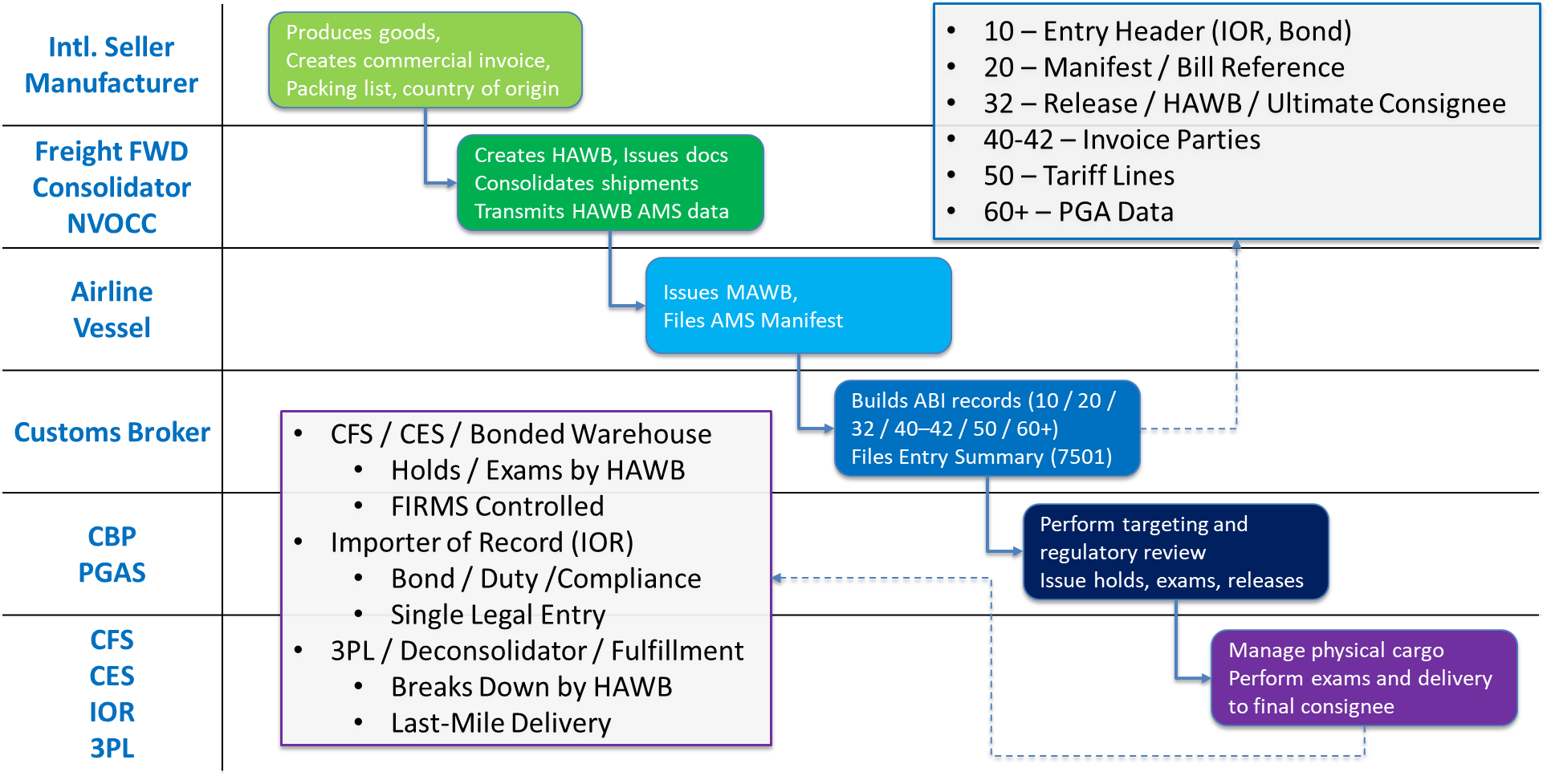
High-level view of who creates which data, and how it flows into CBP filing and warehouse/CFS execution:
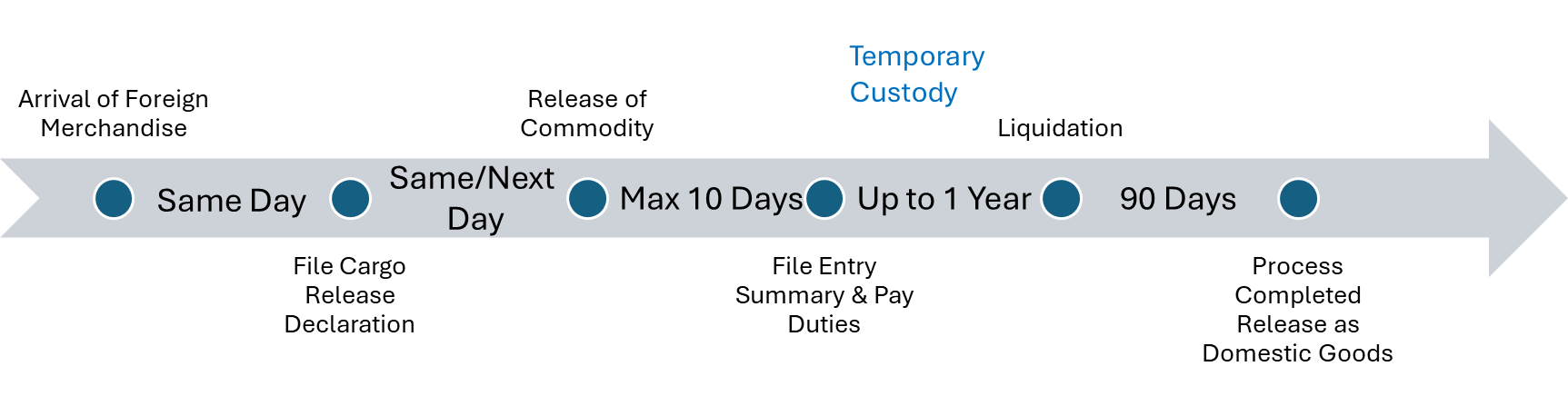
Typical timing windows (varies by mode, program, and exception handling):
To sell products around the world you will need to know your product’s Harmonized System or HS Code. The Harmonized System is recognized as the international product classification system for exports. This video will help you understand more about HS code.
An HTS (Harmonized Tariff Schedule) code is a 10-digit import classification system used in the United States to categorize traded products, determine duty rates, and collect trade statistics. Managed by the US International Trade Commission, these codes are essential for customs compliance, with the first six digits aligning with international HS codes.
Yes—CBP allows tariff line aggregation when the key tariff attributes are identical. For system design, only merge items when these fields match:
hts10 (10-digit HTS)country_of_origin(ISO Country Code)manufacturer_id (MID)spi_code (Special Program Indicator)duty_comp_code (base rate indicator)uom1, uom2 (units of quantity)pga_declare_flag (and any program codes that change required data)Then aggregate totals like qty, entered_value, and dutiable_charges into the grouped tariff line.
In short: HTS lines can be merged only when HTS + COO + MID (and other key duty/PGA attributes) are identical; otherwise each unique combination must be a separate tariff line.
When multiple products share identical tariff attributes (HTS, country of origin, MID, SPI, UOM, rate, PGA flags), CBP allows grouping into one tariff line. Benefits:
| Benefit | Impact |
|---|---|
| Reduce tariff line count | Avoid the 999-line limit |
| Lower MPF by avoiding multiple Entry Summaries | Direct cost savings |
| Reduce errors | Fewer ABI rejects |
| Faster filings | Higher throughput |
| Lower system load | Better performance |
| Cleaner compliance | Easier audits, smoother PGA filing |
Type 01 is a formal consumption entry used for many commercial imports. It’s common when CBP requires formal processing or when shipment details/commodities require a formal entry process.
Type 11 is an informal entry used for eligible shipments that can be processed through an informal workflow. Eligibility depends on CBP rules, commodity, shipment scenario, and value thresholds.
Here’s a quick comparison in a multi-product e-commerce context (high-level; eligibility depends on the shipment):
| Category | Type 01 — Formal Consumption Entry | Type 11 — Informal Entry |
|---|---|---|
| Purpose / Usage | Standard entry for commercial shipments over the $2,500 threshold or for any goods subject to Partner Government Agency (PGA) requirements (FDA, USDA, CPSC, etc.). | Simplified entry for low-value shipments (aggregate value ≤ $2,500) not requiring PGA review. Commonly used for small-parcel e-commerce imports. |
| CBP Form 7501 | ✅ Required. Full Entry Summary listing each HTS line, description, country of origin, entered value, duty rate, and duty amount. | ✅ Simplified. May list summarized information; often processed electronically by brokers or carriers. |
| Value Threshold | > $2,500 (or any regulated commodity regardless of value) | ≤ $2,500 (non-regulated merchandise only) |
| Duty Rate Basis | Calculated per HTS code, using official CBP tariff schedule — can vary (0%, 2.5%, 6.5%, 25%, etc.) by product, material, and country of origin. | Same principle — duty still assessed per HTS line, but since shipment value is low, total duties are minimal. |
| Section 301/232 / Special Tariffs | ✅ Apply when HTS or country triggers them (e.g., China Section 301 25%). | ✅ Apply when applicable; however, limited impact due to small shipment value. |
| Merchandise Processing Fee (MPF) | ✅ 0.3464% of entered value (minimum $31.67 / maximum $614.35 per entry). | ❌ Exempt. No MPF collected on Type 11 informal entries. |
| Harbor Maintenance Fee (HMF) | ❌ Not applicable to air shipments. | ❌ Not applicable to air shipments. |
| Customs Bond Requirement | ✅ Mandatory. Continuous or single-entry bond covers duty and compliance. | ❌ Not required unless CBP requests it. |
| Broker Fee / Service Cost | Typically $100–$200 per formal entry, depending on broker and line count. | $0–$40, depending on carrier or express integrator processing. |
| Processing Speed | Slower — requires full data validation and CBP acceptance. | Faster — simplified electronic release. |
| Recordkeeping | Full retention for 5 years; importer responsible for HTS accuracy. | Simplified retention; carrier/broker often retains limited data. |
| Audit Exposure | Higher (subject to entry audits, CF-28/29 inquiries). | Lower, but CBP can still request post-summary documentation. |
When developing your pricing strategy for an international buyer, you must understand foreign tariffs and how to determine the total export price. The most important factor is to establish the “landed” cost of the transaction. This video will help you determine the landed costs using both tariffs and taxes.
Besides import/export duties, shipments may be subject to U.S. government **user fees** and related charges. Common examples include:
MPF(Merchandise Processing Fee)
HMF(Harbor Maintenance Fee) for certain ocean freight
Other CBP user fees depending on mode/program and service (For CBP’s official list and amounts, see the CBP user fee table)
MPF applies once per Entry Summary, not per Cargo Release.
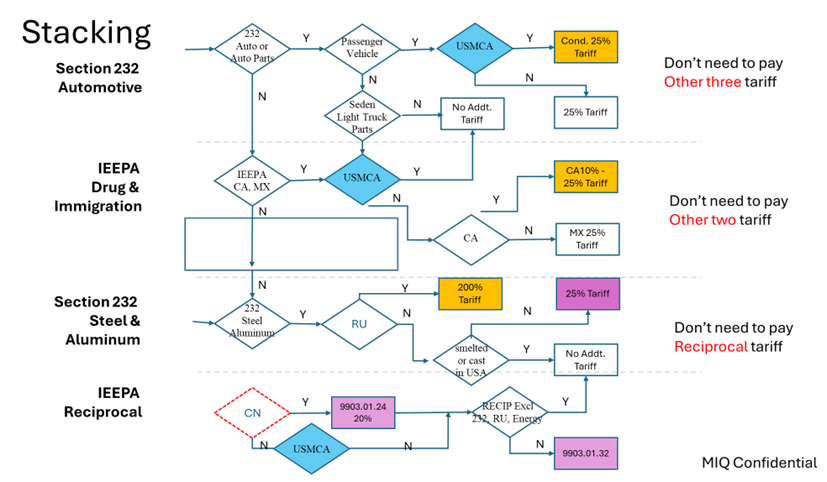
Tariff stacking refers to the cumulative application of multiple U.S. trade duties on a single imported product. Instead of applying only one tariff, CBP may apply several tariffs sequentially, significantly increasing the total landed cost.
Tariffs that commonly stack include:
Typical tariff stacking order (general guidance)
Tariff stacking decision flow
Why this matters
Tariff stacking can turn a modest base duty into a 30%–60%+ total duty. MIQ Express evaluates HTS, origin, and eligibility rules early so teams understand the true landed cost before filing.
MIQ Express validates data, standardizes workflows, and connects entry events with Warehouse/CFS operations and visibility—so teams can resolve exceptions earlier and keep cargo moving.
High-level questions about releasing cargo and responding to CBP actions.
Cargo Release ( CBP Form 3461)is the process where CBP (and sometimes PGAs) determine whether goods can be released from CBP control. Release status can change based on reviews, holds, exams, or missing information.
Common causes include unclear descriptions, missing/invalid party data, inconsistent documents, PGA requirements, admissibility issues, or exam/risk flags.
MIQ Express helps by validating required fields, keeping related documents linked to the shipment, and showing release/hold statuses in a single workflow so ops can act quickly.
A quick overview and the most common questions. (Detailed scenarios are available on request.)
AMS, or the Automated Manifest System, was created by U.S. Customs (CBP). It is an electronic transmission system, for documentation, to U.S. Customs before cargo arrives in the U.S. It largely for security and efficiency purposes. It mainly coordinates information release between parties involved in international shipments, such as Sea Shipping Lines (SSLs), Airlines, Rail Carriers, etc.
Carrier (mandatory) Freight Forwarder (AMS Deconsolidator) Importer or its Broker (ABI: Automated Broker Interface) Express Consignment Facility
AMS must be filed 24 hours or more in advance to its departure from the last foreign port. Suppose you have a shipment coming from Hong Kong, through South Korea, to Seattle. Customs requires that AMS be filed with 24 hours advance to the cargo s departure from its last foreign port at South Korea.
In general, the Carrier is responsible for MAWB Data input, and the Agent (Departure Station) is responsible for HAWB Data input.
Air AMS Data should be sent no later than 4 hours before arrival of the first station in US territory. For MASkargo (Malaysia Airlines Berhad Cargo), the first departure station will be in charge of sending Air AMS data to CBP.
For each irregularity case per MAWB/HAWB, USD5,000 - USD 10,000 will be imposed to the Carrier. According to US DHS Regulation 122.48[c][3], the Carrier could seek re-compensation to the Agent. Cases subject to penalty: Omission of Transmission, Inaccurate Transmission, False Report Shipment of US Embargo items.
" A precise description of cargo, including weight and piece count. " Port where the cargo is loaded. " Last foreign port before the vessel departs for the U.S. " Vessel name, number, country of documentation, Standard Carrier Alpha Code (SCAC), and voyage number. " Scheduled date of arrival at first U.S. port. " First foreign port where the carrier takes possession of cargo. " Hazardous material code. " Container number. " Container seal number -serial number of the last seal applied when the container is loaded
AMS Deconsolidator is a member of CBP that has acquired FIRMS code, and thus authorized to send House Data directly to CBP System. Carriers has no obligations to send House Data of AMS Deconsolidator. FIRMS stand for Facilities Information and Resources Management System
AMS Deconsolidators does not have to reveal internal classified information and can also receive prompt reply from CBP.
Here are a few common Air AMS/CBP scenario Q&As from your original FAQ:
How Could AWB Indicate the Cargo of AMS Deconsolidator?
On 'Handling Information of MAWB', the forwarder should input following data and submit; "HOUSE INFORMATION TRANSMITTED BY Y807" (If the FIRMS CODE is Y807). In the FWB Message, the FIRMS CODE is to be indicated in the OSI line of the message.
Since AMS Deconsolidator Does Not Display HAWB, What Is the Solution to Partial Shipment?
In general, Partial Shipment is prohibited in AMS Deconsolidator. In case of Partial shipment, the Deconsolidator should submit "CUSTOMS Pouch" containing following information to the Carrier (Pouch should be submitted with the AWB) HAWB (CONSOLIDATION) MANIFEST or HAWB Hard Copies Consolidation MFST per pallet: Submit HAWB information on SKID or BUC pallet ex. HAWB BAX11111/34PC-PMC1234KE/20PC, PMC2345KE/14PC
Does Air AMS Apply to The Cargo Via US Whose Final Destination Is Outside of US (Such as Canada)?
Yes. Any MH flight bound for a destination outside of LAX and EWR is subject to Air AMS based on FROB (Foreign Remaining On Board) regulations.
Is the AMS Participant Required to Transmit All the Alphanumeric Characters As Printed On The Paper Copy Of The House Air Waybill?
Yes. The AMS participant is required to report the full House Air Waybill identifier as printed on the hard copy document. This includes alpha characters preceding or contained within the house-level shipment identification.
If A Master Air Waybill Record Has Only A Single House Air Waybill, Is It Possible for The Carrier to Transmit as A Simple Air Waybill?
No. When a master air waybill references only one house air waybill, both the master air waybill and the house air waybill must be reported.
What Is the Proper Method of Entering Shipper and Consignee?
Consol MAWB: The Name & Address of Consolidator/Deconsolidator Single MAWB & HAWB: Actual Name & Address of SHIPPER/CONSIGNEE ex : Name of the Shipper: Up to 35 alphanumeric (including space) Street & Address: Up to 35 alphanumeric (including space) CITY, COUNTRY, TOWNSHIP: Up to 17 alphanumeric (including space) STATE: Up to 9 alphanumeric (including space) Abbreviation is accepted (ex. California - CA) COUNTRY CODE: 2 Letters only (number is not acceptable)
On 'Handling Information of MAWB', the forwarder should input following data and submit; "HOUSE INFORMATION TRANSMITTED BY Y807" (If the FIRMS CODE is Y807). In the FWB Message, the FIRMS CODE is to be indicated in the OSI line of the message.
In general, Partial Shipment is prohibited in AMS Deconsolidator. In case of Partial shipment, the Deconsolidator should submit "CUSTOMS Pouch" containing following information to the Carrier (Pouch should be submitted with the AWB) HAWB (CONSOLIDATION) MANIFEST or HAWB Hard Copies Consolidation MFST per pallet: Submit HAWB information on SKID or BUC pallet ex. HAWB BAX11111/34PC-PMC1234KE/20PC, PMC2345KE/14PC
Yes. Any MH flight bound for a destination outside of LAX and EWR is subject to Air AMS based on FROB (Foreign Remaining On Board) regulations.
Yes. The AMS participant is required to report the full House Air Waybill identifier as printed on the hard copy document. This includes alpha characters preceding or contained within the house-level shipment identification.
No. When a master air waybill references only one house air waybill, both the master air waybill and the house air waybill must be reported.
Consol MAWB: The Name & Address of Consolidator/Deconsolidator Single MAWB & HAWB: Actual Name & Address of SHIPPER/CONSIGNEE ex : Name of the Shipper: Up to 35 alphanumeric (including space) Street & Address: Up to 35 alphanumeric (including space) CITY, COUNTRY, TOWNSHIP: Up to 17 alphanumeric (including space) STATE: Up to 9 alphanumeric (including space) Abbreviation is accepted (ex. California - CA) COUNTRY CODE: 2 Letters only (number is not acceptable)
What ACAS is and what to expect in a typical air export-to-U.S. flow.
ACAS is a CBP air cargo security screening program that uses advance shipment data to assess risk before cargo is loaded and flown to the U.S.
As early as possible—typically before loading. Earlier, cleaner data reduces rejects and “unknown cargo” issues.
Clear commodity description, shipper/consignee details, piece count, weight, routing, and other air shipment identifiers. Exact elements depend on your role (carrier vs forwarder) and message format.
Vague descriptions, inconsistent shipper/consignee info, missing identifiers, or format/character problems. Standardizing descriptions and validating formats helps a lot.
A simple explanation of ISF and how it fits into ocean imports.
ISF is an importer security filing used for ocean shipments. It provides advance data to CBP for risk assessment before the container is loaded and arrives in the U.S.
Commonly before the vessel is loaded at the foreign port (many people refer to this as a 24-hour before loading requirement).
Party information (importer, seller, buyer, ship-to), container/booking details, manufacturer/supplier data, and commodity/HTS-level details depending on the filing approach.
MIQ helps collect standardized party/product data, validates formats, links data to the shipment record, and provides visibility when changes or corrections are needed.
Moving cargo under CBP control and handling it at a Container Freight Station (CFS).
In-bond allows cargo to move within the U.S. under CBP control (for example, from the port of arrival to another location) before final entry/release is completed.
Common cases include moving freight to an inland port, transferring to a different facility for exam/handling, or consolidating/deconsolidating under controlled status.
A CFS (Container Freight Station) is a facility where cargo may be devanned, sorted, examined, or held under CBP control before it is released or moved onward.
A Foreign-Trade Zone (FTZ) is a designated location in the U.S. where manufacturers, and companies that perform value-added processing, can enjoy cost savings by delaying or reducing duty payments on foreign merchandise, as well as other savings. This video will help you understand more about FTZ.
A bonded warehouse is a facility authorized by U.S. Customs and Border Protection (CBP) where imported goods can be stored without immediate payment of duties and taxes.
Duties, taxes, and fees are deferred until the goods are:
Bonded warehouses are commonly used to improve cash flow, manage inventory, support re-export strategies, or hold cargo pending customs clearance, exams, or final distribution decisions.
Both Foreign-Trade Zones (FTZs) and bonded warehouses allow duty deferral, but they serve different operational and compliance purposes.
| Category | Bonded Warehouse | Foreign-Trade Zone (FTZ) |
|---|---|---|
| Primary Purpose | Storage with duty deferral | Manufacturing, assembly, and distribution |
| Duty Payment | Paid when goods enter U.S. commerce | Paid only when goods leave the FTZ for U.S. consumption |
| Manufacturing Allowed | No (limited manipulation only) | Yes (with FTZ Board approval) |
| Time Limit | Up to 5 years | No fixed time limit |
| Weekly Entry Option | No | Yes (reduces MPF costs) |
| Compliance Complexity | Lower | Higher (inventory controls, FTZ reporting) |
In practice, bonded warehouses are ideal for short- to mid-term storage and duty deferral, while FTZs are better suited for high-volume operations, value-added processing, and long-term duty optimization strategies.
Choose based on what you need most: simple duty deferral (bonded warehouse) vs. high-volume optimization and value-added operations (FTZ).
If you tell us your lanes, volume, and what you do inside the facility (store vs. process), MIQ can help you pick the right model and build the workflow to support it.
Not directly. FTZ is a zone status and inventory program, while Entry Type 01 / 11 refers to the customs entry process for consumption.
Here’s the simple way to think about it:
| Scenario | What happens |
|---|---|
| Admit into FTZ | You file an FTZ admission (zone procedures), and duties are generally deferred while goods remain in the FTZ. |
| Withdraw for U.S. consumption | You file the required CBP consumption entry for that withdrawal (often formal depending on goods/value/PGA). |
| Export from FTZ | Goods may be exported without paying U.S. duties (subject to FTZ/CBP rules and documentation). |
MIQ can help by linking FTZ inventory movements to the correct downstream filing path (release workflow, entry type decisions, and audit trail) so your team stays compliant and fast.
MIQ links in-bond status, facility events, and clearance milestones so warehouse/CFS operations can plan labor and flow based on real compliance status—not guesswork.
CBP issues binding advance rulings and other legal decisions in connection with the importation of merchandise into the United States.
Customs Bulletin and Decisions provides a weekly compilation of decisions, rulings, regulations, notices, and abstracts concerning customs and related matters of the U.S. Customs and Border Protection, U.S. Court of Appeals for the Federal Circuit, and U.S. Court of International Trade.
CROSS is a searchable database of CBP rulings that can be retrieved based on simple or complex search characteristics using keywords and Boolean operators.
Requirements for Electronic Ruling Requests. The procedures under this rulings program apply to requests for binding classification rulings under the Harmonized Tariff Schedule (HTS) and certain marking, origin, NAFTA and applicability of Trade Program rulings.
The Harmonized Tariff Schedule of the United States (HTS) sets out the tariff rates and statistical categories for all merchandise imported into the United States. The HTS is based on the international Harmonized System, which is the global system of nomenclature applied to most world trade in goods.
CBP has a number of Informed Compliance Publications (ICPs) in the "What Every Member of the Trade Community Should Know About: ..." series.
As an intellectual property right (IPR) owner, you can partner with CBP to receive border enforcement of your registered trademarks and copyrights through CBP’s e-Recordation Program.
The Intellectual Property Rights Search (IPRS) is a database containing public versions of U.S. Customs and Border Protection (CBP) intellectual property rights recordations.
This Encyclopedia is intended to provide guidance and information to the trade community.
CBP publishes several Directives and Handbooks, which provide guidance to the public on a variety of trade-related matters.
RLF builds on EIP and allows participants to file an electronic entry package for certain entry types from a location other than the port of arrival or the examination location.
These Dictionaries provide guidance and explanations for errors returned on electronic data submitted to CBP via ACE.
A high-level guide to “when” each program typically happens in the workflow. Failure to file on time may result in penalties, storage charges, or movement of goods to a General Order (GO) warehouse.
Search the glossary for common trade and customs terms.
| Acronym | Description |
|---|---|
| ABI | Automated Broker Interface, a module of CBP Automated Commercial System |
| ACE | Automated Commercial Environment |
| ACS | Automated Commercial System. U.S. Customs and Border Protection (CBP) electronic entry/manifest processing system |
| AES | Automated Export System |
| AGT | Agent. (Message Line Identifier) |
| AAMS | AMS |
| AMS | Automated Manifest System. Comprised of Air, Sea/Rail modules of ACS |
| ARR | Arrival detail. (Message Line Identifier) |
| AWB | Air waybill (Message Line Identifier) |
| ASN | Airline Status Notification. (Message Line Identifier) |
| ATA | Air Transport Association of America |
| ATS | Automated Targeting System |
| B/L or BOL | Bill of Lading |
| CAN | Customs Assigned Number |
| CAMIR | Customs Automated Manifest Interface Requirements |
| CBP | U.S. Customs and Border Protection |
| CCL | Cargo Control Location. (Message Line Identifier) |
| CCS | Cargo and Conveyance Security |
| CED | Customs Express Detail (Message Line Identifier). |
| CFR or CR | Code of Federal Regulations or Customs Regulations |
| CFS | Container Freight Station (also known as Deconsolidator) |
| CHB | Customs House Broker |
| CNE | Consignee. (Message Line Identifier) |
| CSM | Container Status Message |
| COAC | Commercial Operations Advisory Committee of the Customs Service |
| CRLF | Carriage Return and Line Feed (end-of-line character string) |
| CSD | Customs Shipment Description. (Message Line Identifier) |
| CSI | Container Security Initiative |
| CSN | Customs Status Notification. (Message Line Identifier) |
| CT | Compliant Transaction |
| C-TPAT | The Customs-Trade Partnership Against Terrorism |
| CTO | Cargo Terminal Operator. FIRMS or carrier code. |
| DEP | Departure. (Message Line Identifier) |
| DHS | Department of Homeland Security |
| DNL | Do Not Load |
| ECCF | Express Cargo Clearance Facility |
| EIN | Employer Identification Number |
| ERF | Error Report Flight (Message Line Identifier) |
| ERR | Error. (Message Line Identifier) |
| FCL | Full Container Load |
| FDM | Flight Departure Message. (Message Type) |
| FER | Freight Error Report. (Message Type) |
| FIRMS | Facility Information Resource Management System |
| FR | Flexible Range |
| FRC | Freight Report Change. (Message Type) |
| FRI | Freight Report Inbound. (Message Type) |
| FROB | Foreign Cargo Remaining on Board |
| FSC | Freight Status Condition. (Message Type) |
| FRX | Freight Report Cancellation. (Message Type) |
| FSI | Freight Status Information (Message Type) |
| FSN | Freight Status Notification. (Message Type) |
| FSQ | Freight Status Query. (Message Type) |
| FXC | Freight Express Change. (Message Type) |
| FT | Flexible Timing |
| FTZ | Foreign Trade Zone |
| FX | Flexible Range and Flexible Timing |
| FXI | Freight Express Inbound. (Message Type) |
| FXX | Freight Express Cancellation. (Message Type) |
| GMT | Greenwich Mean Time |
| G.O. | General Order. |
| HAWB | House Air Waybill |
| HHG/PE | Household Goods/Personal Effects |
| HTS/HTSUS | Harmonized Tariff Schedule/of the United States |
| HUB | Private type of courier express facility (exclusive to operating air courier) |
| IATA | International Air Transportation Association |
| IATA CARGO IMP | IATA Cargo Interchange Message Procedures. |
| IB | In-Bond |
| ICAO | International Civil Aviation Organization. Issuer of the Three-Letter Airline Designator |
| IE | Immediate Exportation or Informal Entry under Customs bond. |
| IFR | Interim Final Rule |
| IOR | Importer of Record Number |
| ISA | Interconnection Security Agreement |
| ISO | International Standards Organization |
| IT | Immediate Transportation under Customs Bond |
| LCL | Less Than Container Load |
| MAWB | Master air waybill for consolidation. |
| MDR | Manifest Discrepancy Report. |
| MID | Manufacturer Identification Number |
| MOD | Modification |
| NPRM | Notice of Proposed Rulemaking (2003.7.23) |
| NVOCC | Non-Vessel Operating Common Carrier |
| RIA | Regulatory Impact Analysis |
| OCS | Outer Continental Shelf |
| POA | Power of Attorney |
| PTP | Permit To Proceed. |
| RFA | Reason For Amendment. (Message Line Identifier) |
| RO-RO | Roll On-Roll Off |
| SCAC | Standard Carrier Alpha Code (not supported by AMS) |
| SHP | Shipper |
| SMI | Standard Message Identifier. |
| T&E | Transportation and Exportation under Customs bond. |
| TRN | Transfer |
| TSA | Transportation Security Administration |
| TXT | Text explanation |
| XACTION | Transaction |
| XFER | Transfer |
| XMIT | Transmit |
| US | United States |
| USPS | United States Postal Service |
| VOC | Vessel Operating Carrier |
| WBL | Waybill |
Tell us your volumes, origins, and facility needs. We’ll propose a practical rollout for T01/T11, AMS/ACAS/ISF, In-Bond/CFS, and end-to-end visibility.